
Real estate lawyer rates are the fees charged by licensed legal professionals to handle property transactions, and in Ontario they typically fall between $500 and $1,500 as a flat fee for standard residential deals. For complex or unpredictable matters, hourly rates range from $150 to $500, with commercial or heavily disputed cases reaching $5,000 or more. These figures represent only the professional fee. Land transfer tax, title insurance, and government registration costs sit on top of that number and can add thousands to your closing bill. Knowing the difference before you sign anything puts you in a far stronger position.
What factors influence real estate lawyer rates in Ontario?
Real estate lawyer fees in Ontario are not one-size-fits-all. Several variables push the number up or down, and understanding them helps you budget accurately rather than guess.
Transaction type and complexity sit at the top of the list. A standard residential purchase follows a predictable path, which is why lawyers can quote a flat fee with confidence. A commercial acquisition, a title dispute, or a purchase involving an unregistered easement requires open-ended legal work. Complex or unpredictable cases shift billing from flat fee to hourly, and that shift can significantly change your total cost.

Geographic location within Ontario also matters. Urban centres like Toronto, Mississauga, and Ottawa carry higher overhead costs for law firms, and those costs pass through to clients. Urban legal markets charge higher flat fees and hourly rates compared to suburban or rural areas. A lawyer in a smaller Ontario town may quote $700 for a purchase closing that a downtown Toronto firm prices at $1,200.
Lawyer experience and firm size affect pricing too. Senior lawyers at established firms charge more per hour. That premium often reflects faster turnaround, fewer errors, and deeper knowledge of local title issues.
Key factors that shape your final bill:
- Transaction type: residential purchase, sale, refinancing, or commercial deal
- Complexity: standard closing versus title defects, disputes, or zoning challenges
- Location: urban Ontario versus suburban or rural markets
- Lawyer experience and firm reputation
- Whether disbursements are bundled or billed separately
Pro Tip: Always ask for a written fee estimate that separates professional fees from disbursements. Written fee estimates prevent the most common billing surprises at closing.
How do flat fees and hourly rates work for real estate legal services?
The two billing models in real estate law serve very different purposes. Choosing the wrong one, or not understanding which applies to your file, is where most cost confusion begins.
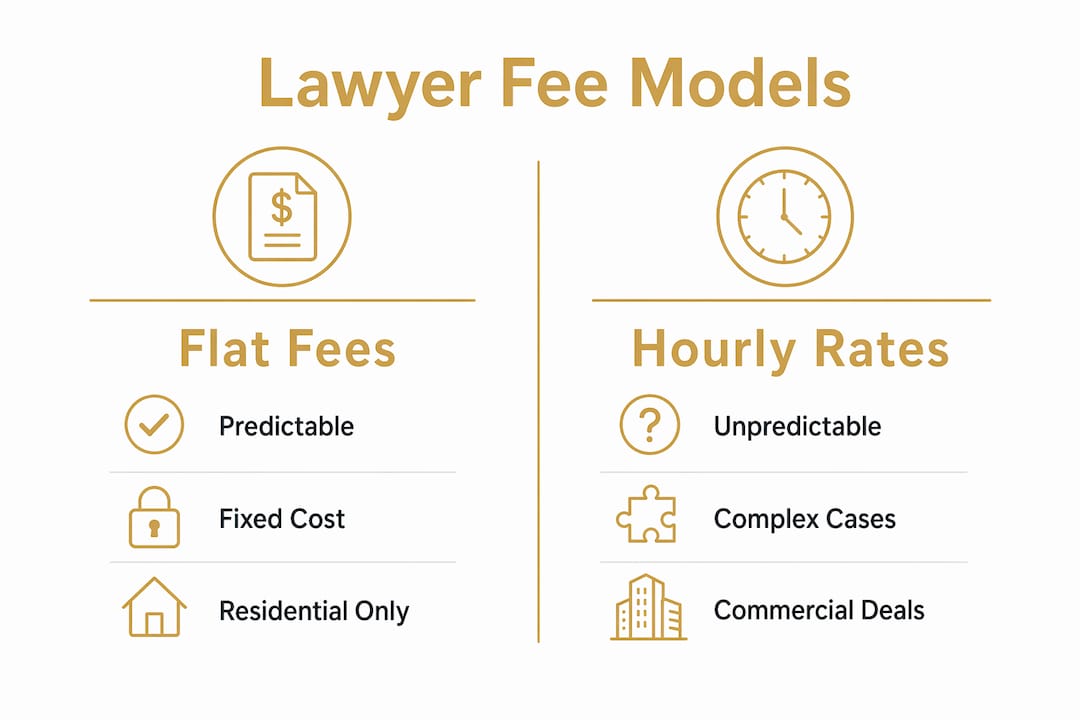
Flat fees work for transactions with a predictable scope. A standard residential purchase in Ontario follows a defined set of steps: title search, review of the agreement of purchase and sale, preparation of closing documents, and registration. Because a lawyer can estimate the time required with reasonable accuracy, they quote a single fixed number. Flat fees for standard residential closings in 2026 Ontario typically range from $500 to $1,500. That predictability is the main benefit for buyers and sellers.
Hourly billing applies when the scope cannot be defined upfront. Title defects, boundary disputes, litigation, and zoning challenges all fall into this category. Hourly rates generally range from $250 to $450 for real estate matters, though senior counsel at larger Toronto firms can charge more. Lawyers handling litigation often require a retainer before work begins, drawing down against hours logged.
Here is how common transaction types map to billing models:
- Standard residential purchase or sale: flat fee, typically $500–$1,500, covering contract review, title search, deed preparation, and closing coordination
- Refinancing: flat fee, generally $575–$1,000, reflecting a streamlined legal process with fewer steps than a full purchase
- Contract review only: flat fee or hourly, typically $400–$700 for flagging unfavourable terms
- Title dispute or defect resolution: hourly billing, scope open-ended
- Real estate litigation: hourly with retainer, costs can reach $5,000 or well beyond
Pro Tip: A flat fee only holds if your file stays predictable. Unregistered easements or missing signatures can shift your billing to hourly mid-file. Ask your lawyer upfront what circumstances would trigger that switch.
What additional costs should buyers and sellers expect beyond lawyer fees?
The professional fee your lawyer quotes covers their time and expertise. It does not cover the third-party costs required to complete a property transaction in Ontario. These disbursements are real, substantial, and non-negotiable.
Legal fees do not include land transfer tax, title insurance, or government recording fees. In Ontario, land transfer tax is calculated as a percentage of the purchase price and applies provincially, with an additional municipal layer for Toronto properties. That cost alone can run into the tens of thousands on a typical GTA home. A detailed breakdown of these costs appears in the 2026 closing costs guide published by Realestatelawyer-toronto.
| Disbursement | Typical Ontario range |
|---|---|
| Title insurance premium | $500–$2,000 |
| Title search fees | $200–$600 |
| Government registration fees | $25–$250 |
| Courier and document fees | $50–$150 |
| Land transfer tax | Varies by purchase price |
Title insurance protects against defects in the chain of ownership, survey errors, and certain types of fraud. It is not optional in practice, even when not legally mandated. Title search fees cover the cost of pulling historical ownership records and checking for liens or encumbrances. These are billed as add-ons regardless of whether your lawyer charges a flat fee or hourly rate.
Request an itemised cost estimate before retaining any lawyer. That document should list professional fees and every anticipated disbursement as separate line items.
How to find and evaluate real estate lawyers in Ontario based on rates
Selecting a lawyer based on price alone is a reliable way to create problems at closing. The goal is to find someone whose fee is fair, whose scope is clear, and whose communication is direct.
Practical steps for evaluating real estate lawyers in Ontario:
- Get written estimates from at least two lawyers. Verbal quotes are not binding. A written engagement letter or fee estimate is the only document that protects you if billing disputes arise.
- Ask what the flat fee includes and excludes. Standard closing packages cover contract review, deed preparation, and closing coordination, but exclude major litigation or title defect resolution. Confirm this in writing.
- Treat fees below $500 as a red flag. Rates under $500 may indicate limited experience or a scope so narrow that additional charges will appear later. The risk is not worth the apparent saving.
- Ask about the transition to hourly billing. Understand exactly which circumstances would move your file from flat fee to hourly, and what the hourly rate would be.
- Verify the lawyer’s focus area. A lawyer who handles real estate transactions regularly will complete your file faster and catch issues that a generalist might miss.
For buyers in Toronto, Realestatelawyer-toronto offers residential purchase services with transparent fee structures and direct access to the lawyers handling your file. That direct access matters when questions arise close to closing day.
How do real estate lawyer fees compare to overall transaction costs?
Legal fees represent a small fraction of what you spend to buy or sell a property in Ontario. Understanding that proportion helps you see where legal counsel sits in the broader picture and why skipping it is rarely the saving it appears to be.
Real estate agent commissions typically run 2.5% to 3% of the sale price. On a $700,000 home, that is $17,500 to $21,000. A lawyer handling the same transaction charges $500 to $1,500. The scope is narrower, but the legal work is the part that protects your ownership rights, confirms the title is clean, and registers the transfer correctly.
Realtors and lawyers serve different functions. A realtor markets the property, negotiates the price, and manages the offer process. A lawyer reviews the legal terms of the agreement, conducts the title search, manages funds in trust, and registers the deed. Neither replaces the other. Skipping legal counsel to save $1,000 on a $700,000 transaction is a disproportionate risk.
For sellers, the residential sale process involves its own legal requirements, including discharging any existing mortgage, preparing the transfer documents, and distributing sale proceeds correctly. These steps require a licensed lawyer in Ontario. There is no legal alternative.
Key takeaways
Real estate lawyer rates in Ontario range from $500 to $1,500 for standard residential transactions, with hourly billing between $150 and $500 applying to complex or disputed matters, and disbursements always billed separately on top.
| Point | Details |
|---|---|
| Flat fee range | Standard residential closings cost $500–$1,500 in Ontario in 2026. |
| Hourly billing triggers | Disputes, title defects, and litigation shift billing to $150–$500 per hour. |
| Disbursements are separate | Title insurance, land transfer tax, and registration fees are never included in the lawyer’s professional fee. |
| Red flag pricing | Fees below $500 often signal limited experience or a scope that will generate add-on charges. |
| Written estimates matter | Always request an itemised fee estimate before retaining a lawyer to avoid closing-day surprises. |
What I’ve learned about legal fees after watching hundreds of closings
The single most common complaint I hear from buyers and sellers is not that their lawyer charged too much. It is that they did not understand what they were paying for until the bill arrived. That gap between expectation and reality is entirely preventable.
Flat fees create a false sense of certainty. Clients hear “$1,100 all-in” and stop asking questions. Then an issue surfaces during the title search, or the seller’s mortgage discharge is delayed, and suddenly the file requires additional hours. A good lawyer explains this risk upfront. A great lawyer puts it in writing.
The other pattern I see consistently: buyers focus on the lawyer’s fee while ignoring disbursements. A $900 legal fee on a Toronto purchase can sit alongside $3,000 in disbursements and land transfer tax in the tens of thousands. The lawyer’s fee is genuinely the smallest number on that page.
My honest advice is to treat the legal fee as an investment in certainty, not a cost to minimise. A lawyer who charges $1,200 and communicates clearly throughout the process is worth more than one who quotes $750 and is unreachable when the closing hits a complication. Ask direct questions. Get written answers. The closing day experience, as Realestatelawyer-toronto explains in their closing day guide, is the moment all that preparation either holds together or falls apart.
— Marketing
Trusted legal guidance for Ontario property transactions
Realestatelawyer-toronto, operating as Sarkaria Sethi LLP, handles residential purchases, sales, refinancing, and complex real estate disputes across Ontario with clear, upfront fee structures.

Every client at Realestatelawyer-toronto works directly with the lawyer managing their file, not a rotating team of assistants. That direct access means faster answers and fewer surprises at closing. Whether you need a straightforward residential closing or representation in a real estate dispute, the firm provides written fee estimates before any work begins. For buyers and sellers who want to understand exactly what they are paying and why, the Toronto real estate lawyer guide is a practical starting point.
FAQ
What is the average real estate lawyer fee in Ontario in 2026?
Flat fees for standard residential transactions in Ontario typically range from $500 to $1,500 in 2026, with disbursements such as title insurance and registration fees billed separately on top.
When does a real estate lawyer charge hourly instead of a flat fee?
Lawyers switch to hourly billing when a file becomes unpredictable, such as when title defects, boundary disputes, or litigation arise. Hourly rates generally range from $150 to $500 depending on the lawyer’s experience and location.
Are disbursements included in the lawyer’s quoted fee?
Disbursements are not included in the professional fee. Title insurance, title search fees, government registration costs, and land transfer tax are all separate expenses that must be budgeted in addition to the lawyer’s fee.
Is a real estate lawyer required for property transactions in Ontario?
Yes. Ontario law requires a licensed lawyer to register property transfers, manage funds in trust, and discharge existing mortgages. There is no legal alternative to retaining a lawyer for a closing in this province.
What is a red flag when reviewing a real estate lawyer’s quote?
Fees quoted below $500 for a full residential closing warrant scrutiny. Unusually low pricing often reflects limited experience or a narrow scope that will generate additional charges once the file is underway.