A real estate litigation lawyer is a legal professional who represents clients in court disputes arising from property transactions, ownership conflicts, and lease disagreements in Ontario. These disputes rarely resolve themselves. Without proper legal representation, you risk losing significant financial interests, missing critical procedural deadlines, or accepting settlements far below what you are owed. Ontario’s court system has specific rules, jurisdictional limits, and, as of 2026, a reformed procedural framework that changes how cases move from filing to resolution. Knowing how this system works, and having a qualified property dispute attorney in your corner, is the difference between enforcing your rights and watching them expire.
What types of real estate disputes require a litigation lawyer in Ontario?
Real estate disputes in Ontario cover a wide range of conflicts, and not all of them are obvious candidates for litigation until they escalate. A housing litigation attorney helps you identify when negotiation has failed and court action is the only path forward.
The most common disputes that require a real estate lawsuit lawyer include:
- Purchase and sale failures. A buyer or seller backs out of a signed Agreement of Purchase and Sale. The injured party may sue for damages or seek specific performance to force the transaction to close.
- Title disputes and boundary conflicts. Competing claims over who legally owns a property, or where one property ends and another begins, require a thorough title investigation and often court intervention.
- Latent defects. A seller fails to disclose a hidden structural problem, water damage, or environmental issue. Suing for latent defects in Toronto real estate is a well-established legal avenue for buyers who discover problems after closing.
- Landlord and tenant conflicts. A landlord tenant lawyer handles disputes over unpaid rent, illegal evictions, lease breaches, and habitability issues that fall outside the Landlord and Tenant Board’s jurisdiction or involve commercial tenancies.
- Commercial real estate conflicts. Commercial real estate disputes often involve lease disagreements, zoning issues, and title concerns that require specialized litigation expertise.
- Joint ownership and partition matters. When co-owners cannot agree on selling or managing a property, a court can order a forced sale of jointly owned property through a partition application.
Pro Tip: If you have received a formal legal notice related to a property dispute, treat it as urgent. Missing a response deadline can result in a default judgment against you, regardless of the merits of your position.
How does the Ontario court system handle real estate litigation cases?
The court you file in depends entirely on the dollar value of your claim. Ontario Small Claims Court handles claims up to $50,000. Any claim above that threshold goes to the Ontario Superior Court of Justice, which operates under more complex procedural rules and typically requires legal representation to navigate effectively.

The 2026 three-track procedural framework
Ontario’s 2026 civil litigation reforms introduced a three-track system designed to match procedure to case complexity. Each track serves a different purpose.
| Track | Best suited for | Key feature |
|---|---|---|
| Application | Straightforward legal questions | Decided on written record, no trial |
| Summary | Mid-complexity disputes | Streamlined hearings, limited discovery |
| Trial | Complex, high-value disputes | Full evidentiary process, oral testimony |
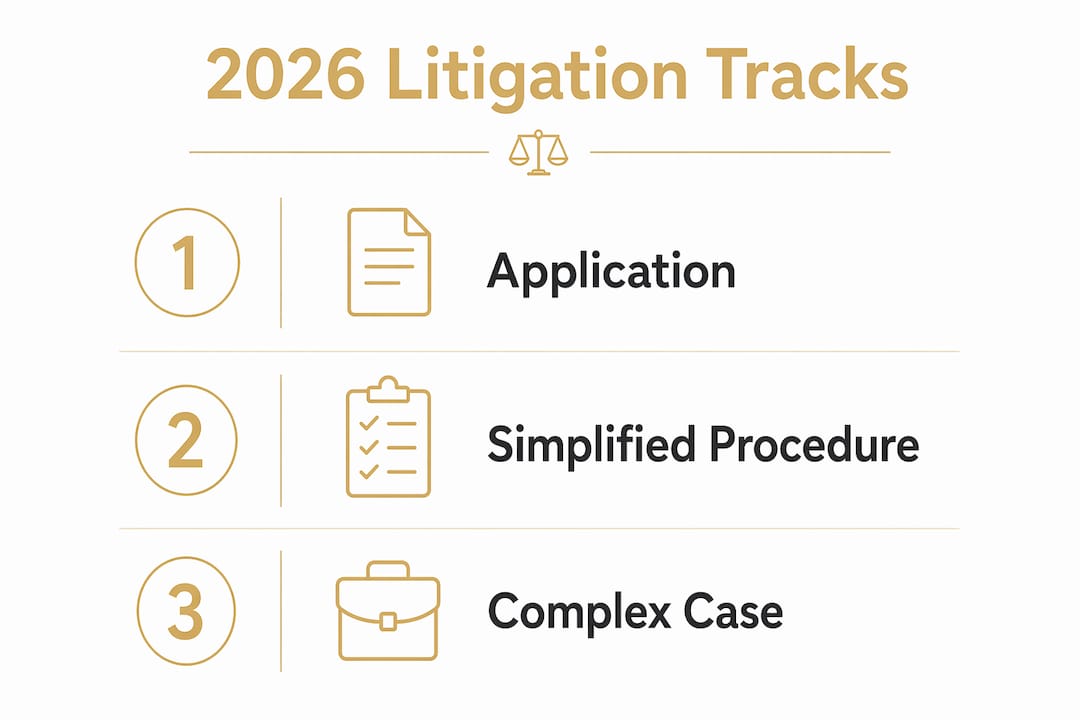
Real estate cases land in different tracks depending on the facts. A boundary dispute with clear documentary evidence may resolve on the Application track. A failed commercial transaction with competing expert witnesses will almost certainly go to Trial.
Key timelines and procedural steps
After being served a Statement of Claim, defendants have 20 days to file a Statement of Defence. Missing that window can result in a default judgment, meaning the court rules against you without hearing your side. After pleadings close, an Ontario Superior Court Directions Conference sets the timetable for evidence exchange, mediation, and any summary hearings. Remedies available across these forums include monetary damages, injunctions to stop harmful conduct, and specific performance orders that compel a party to complete a transaction.
Pro Tip: Never assume you have more time than the rules allow. Procedural deadlines in Ontario civil litigation are strict. A real estate attorney who knows the Rules of Civil Procedure will protect you from costly missteps.
What are strategic legal approaches used by real estate litigation lawyers?
A skilled real estate attorney does not go straight to court. The most effective legal strategies begin before a claim is ever filed, and they are built around the specific facts of your dispute.
-
Send a formal demand letter. Early demand letters significantly increase the chance of pre-litigation resolution. A well-drafted letter signals that you are serious, documents your position, and often prompts the other party to negotiate rather than face court costs.
-
File a properly structured Statement of Claim. Drafting a Statement of Claim that meets Rule 14 of Ontario’s Rules of Civil Procedure is complex. The document must plead material facts, not just conclusions. Errors at this stage can weaken your entire case.
-
Sue for specific performance. When a seller refuses to close on a signed agreement, suing for specific performance asks the court to order the transaction completed rather than simply awarding damages. Ontario courts grant this remedy when the property is unique and money alone cannot compensate the buyer.
-
Pursue title and latent defect claims. Title disputes require documentary evidence, historical records, and often expert testimony. Latent defect claims require proof that the seller knew about the problem and deliberately concealed it.
-
Negotiate a settlement through mediation. Most Superior Court cases in Ontario go through mandatory mediation before trial. A commercial real estate attorney who prepares thoroughly for mediation often achieves a better outcome than one who treats it as a formality.
The right strategy depends on your goals. If you want the deal to close, specific performance is your primary tool. If you want compensation for losses, a damages claim is the path. A litigation lawyer maps the strategy to the outcome you actually need.
How can you enforce property rights with a litigation lawyer’s help?
Working with a real estate litigation lawyer means understanding what to expect at each stage and how to make the process work in your favour.
- Respond to claims immediately. If you are served with a Statement of Claim, the 20-day deadline to file a Statement of Defence is not negotiable. Contact a property dispute attorney the same day you receive the documents.
- Gather evidence early. Contracts, emails, text messages, inspection reports, and photographs are all potentially critical. Your lawyer will advise you on what to preserve and how to organism it for disclosure.
- Engage expert witnesses when needed. Property valuation disputes, latent defect cases, and boundary conflicts often require qualified experts. A housing litigation attorney coordinates expert reports and prepares witnesses for examination.
- Understand post-judgment enforcement. Winning a judgment is not the end. If the other party does not pay voluntarily, enforcement actions such as garnishment of bank accounts, writs of seizure, and sale orders become necessary. Your lawyer manages this process.
- Communicate clearly with your legal team. The clients who get the best outcomes are those who respond promptly to requests for documents, ask questions when they do not understand a step, and trust their lawyer’s procedural guidance.
Pro Tip: Keep a written record of every conversation related to your dispute, including dates, names, and what was said. This documentation can become evidence, and it helps your lawyer build a precise timeline of events.
Key takeaways
A real estate litigation lawyer is your most effective tool for enforcing property rights in Ontario, from the first demand letter through to post-judgment collection.
| Point | Details |
|---|---|
| Court jurisdiction matters | Claims up to $50,000 go to Small Claims Court; larger disputes require Ontario Superior Court. |
| 2026 reforms changed procedure | The new three-track system assigns cases to Application, Summary, or Trial based on complexity. |
| Deadlines are non-negotiable | Defendants have 20 days to file a Statement of Defence after being served or risk default judgment. |
| Strategy precedes litigation | Demand letters and mediation often resolve disputes faster and at lower cost than a full trial. |
| Enforcement requires follow-through | A court judgment is only valuable if you pursue garnishment or seizure orders when payment is refused. |
Why Ontario real estate disputes are not a DIY project
Self-represented litigants in Ontario real estate cases face a structural disadvantage that goes beyond simply not knowing the rules. The opposing party’s lawyer knows the rules, knows the judges’ preferences, and knows how to use procedural tools to delay or complicate your case. I have seen straightforward disputes become multi-year ordeals because one party filed the wrong document or missed a Directions Conference.
The 2026 procedural reforms are genuinely significant. The three-track system was designed to reduce delay, but it also means cases are sorted and scheduled faster than before. If you are not ready when your case is assigned to a track, you lose ground quickly. A real estate attorney who has worked under the new framework knows how to position your case from day one.
The other thing I would say plainly: specialisation matters enormously. A lawyer who practises general civil litigation but rarely handles property disputes will miss the nuances of title law, the specific defences available in latent defect cases, and the tactical value of a well-timed specific performance application. Ontario real estate law is its own discipline. Treat it that way when choosing your representation.
— Marketing
Real estate litigation support from Realestatelawyer-toronto
Sarkaria Sethi LLP, operating as Realestatelawyer-toronto, represents Ontario clients across the full range of property disputes, from failed purchase agreements and latent defect claims to commercial lease conflicts and partition applications.

The firm’s client-first approach means you work directly with a dedicated lawyer who knows your file, not a rotating team of assistants. Whether you need a demand letter drafted today or representation through a full Superior Court trial, Realestatelawyer-toronto provides clear, practical advice at every stage. Visit the real estate litigation services page to learn how the firm can help you protect your property interests and move your dispute toward resolution.
FAQ
What does a real estate litigation lawyer do?
A real estate litigation lawyer represents clients in court disputes involving property transactions, title conflicts, lease disagreements, and latent defect claims. They manage everything from drafting the initial Statement of Claim through to post-judgment enforcement.
How do I know if my dispute goes to Small Claims Court or Superior Court?
Claims up to $50,000 are handled by Ontario Small Claims Court. Disputes above that threshold go to the Ontario Superior Court of Justice, which involves more complex procedural rules and typically requires legal representation.
What is specific performance in a real estate dispute?
Specific performance is a court order that forces a party to complete a real estate transaction rather than simply paying damages. Ontario courts grant it when the property is unique and monetary compensation alone would not adequately remedy the loss.
How long do I have to respond to a Statement of Claim in Ontario?
Defendants generally have 20 days to file a Statement of Defence after being served. Missing this deadline can result in a default judgment, meaning the court rules against you without hearing your position.
Can a real estate dispute be resolved without going to trial?
Most disputes resolve before trial through demand letters, negotiation, or mandatory mediation. Ontario Superior Court cases go through a Directions Conference that schedules mediation as a required step before any trial date is set.